


What's my process for driving a creative team? With examples.
Article
Production Designer, Virtual Art Department
Source
Felix Jorge
Date
2026
I've been art directing since The Jungle Book in 2015, and just production designed a film for Kevin Hart’s Hartbeat Productions in 2026. I feel like the job hasn't changed much since I started: sit with the director, the head of art and whoever is doing camera/lighting, work through what they're after in a scene, then build reference boards, key imagery, and guide the team towards the picture that captures their vision.
I get there with concept art, previs, CG animation, virtual production, and traditional VFX. I love environment design and composition, and I'm always getting my hands on an image when I can.
Black Adam
I was Art Director for the Virtual Art Department on Black Adam, under the Production Designer, Tom Meyer.
The aim was to turn Tom's concepts into virtual locations and work through every sequence in the film with the key creatives, before previs, construction, or VFX were onboarded. I managed a team of about eight Unreal Engine artists, two engineers, one animator. Gave notes daily, stayed in the engine myself creating key-images/reference, and stood up a in-house VR scout room so the filmmakers could virtually-scout from Burbank several times a week. We delivered storyboards and assets to Day for Nite for previs.
Guided a team that created virtual sets and key imagery, built and lit in Unreal, used as virtual storyboards for director Jaume Collet-Serra, production designer Tom Meyer and VFX supervisor Bill Westenhofer, among others
Led the sessions with filmmakers in the VR scout room
Contributed to the creation of concept imagery and previs out of Unreal Engine
Created pass off documentation for previs, construction, and VFX

Clockwise from top left: the Kahndaq market street built and lit in Unreal, the VR scout room mid-session in Burbank, a key image pulled from Unreal Engine, and a pass off page showing the tomb interior pristine and present.
The Mandalorian Season 1 & Star Wars Universe
I was Art Director for the Virtual Art Department on The Mandalorian Season 1, under Production Designer Andrew Jones. Our work on that season won us an Emmy. I went on to produce six more seasons with Lucasfilm.
I was brought in to build a workflow for designing sets in Unreal Engine and lead a team creating them alongside the filmmakers. At the time I was employeed by a studio I founded, Happy Mushroom (later on rebranded to Narwhal Studios). Over roughly seven months a ten-artist department built and lit 12 hero locations and 45+ virtual sets for direct handoff to ILM, with another eight-person team off-campus cleaning up our photogrammetry captures of set decoration. I managed the schedule, created key imagery, critiqued the work daily, worked out pipeline problems with The Third Floor and ILM, and set up the weekly virtual scout so the filmmakers could walk a location, give notes, and come back to see them addressed. I also set up Halon working underneath my team, which was their introduction to the virtual art department.
I worked on hero locations in Unreal Engine, with 65+ set dressing assets from photogrammetry. Scene layout, asset building, lighting, fx.
Led virtual location scouts with Jon Favreau, Dave Filoni, Greig Fraser and Andrew Jones, plus their extended teams, including VP Producer Clint Spillers, Set Decorator Amanda Serino and the previs supervisors
Asset management and revision control across art department, VAD, previs and photogrammetry, in-house and external.
As producer on the seasons that followed, I built the teams, workflows, budgets and schedules, producing in-house at Narwhal Studios, which provided the artists, equipment and resources to build those worlds. As shows started overlapping, we scaled to several teams running at once, replicating the core team and building new ones around it.
Star Wars seasons
The Mandalorian S1 · Work Page · VAD Art Director
The Mandalorian S2 · VP Producer, Narwhal Studios
The Book of Boba Fett · VP Producer, Narwhal Studios
Obi-Wan Kenobi · Work Page · VP Producer, Narwhal Studios
The Mandalorian S3 · VP Producer, Narwhal Studios
Ahsoka · Work Page · VP Producer, Narwhal Studios
Skeleton Crew · VP Producer, Narwhal Studios

Clockwise from top left: Nevarro alley as the VAD delivered it, Jon Favreau scouting the set in headset, a prelight session planning with Jon Favreau and Greig Fraser, and set dressing staged for photogrammetry capture.
If you're interested in a detailed look at my virtual-set creation process: Ahsoka’s Set Creation Process
Credits
Art Director
The Jungle Book · The Mandalorian S1 · Black Adam · Black Mask (Production Designer) · Jurassic World VR
Set Designer / Environment Artist
Alice in Wonderland · Iron Man 2 · Oz the Great and Powerful · Total Recall · Oblivion · X-Men: Days of Future Past · Avengers: Age of Ultron · Mad Max: Fury Road · StarCraft II (Cinematics) · How to Train Your Dragon: Dragon Gliders · Command & Conquer (Cinematics) · Mouse Guard · The Call of the Wild
Additional Imagery

The Mandalorian VAD floor. Ten artists, seven months, twelve hero locations.

Production Designer Andrew Jones and Set Decorator Amanda Serino reviewing a set in the engine.

One of the 65+ set dressing pieces captured photogrammetrically and rebuilt for the volume.

The proof of concept stage test, shot through camera. This is the frame that convinced everyone the workflow held up.
Virtual Art Department next to final pixel.

A real-time environment created through the multi-user virtual scout process.

The Black Adam sequence wall. Every shot printed and pinned so the whole department could see where a scene sat.

The VAD schedule, wall length. Eight artists, every set tracked against the shoot.

Working notes from a session.
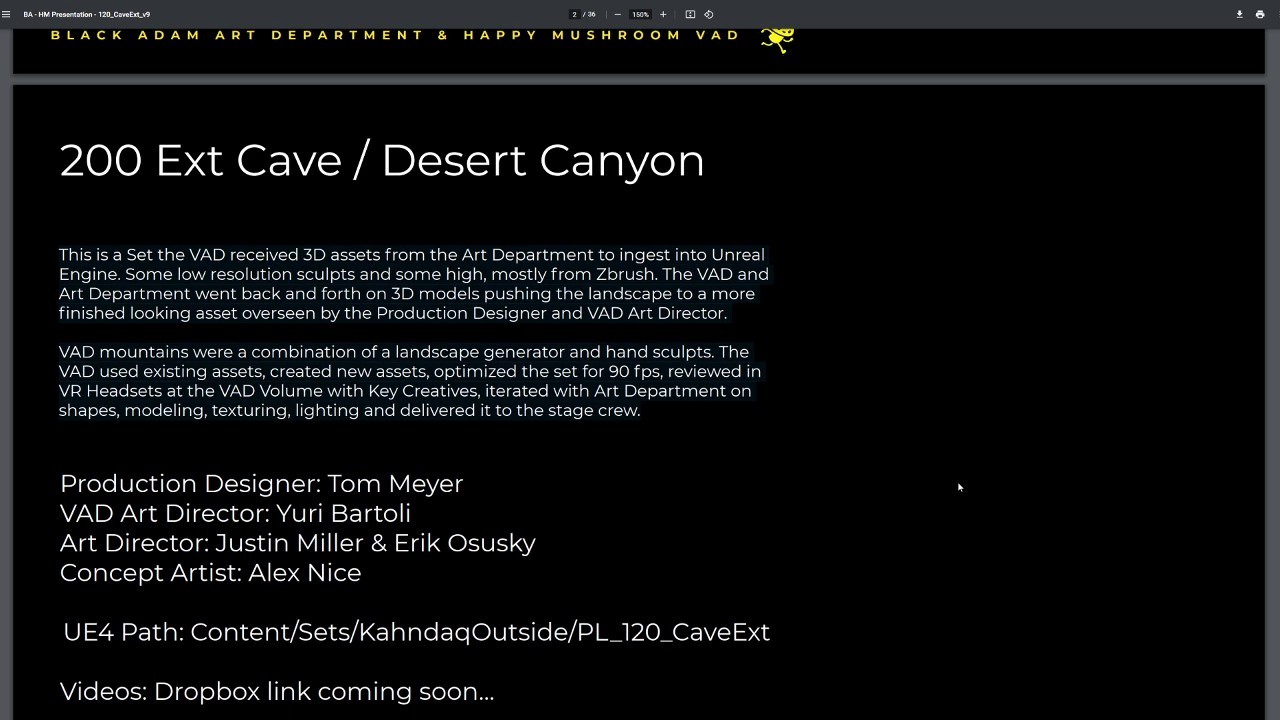
A pass off page. How the set was built, who built it, where it lives in the project.

Curated reference sent with the set so the next department matched intent, not guesswork.