


Why are production designers using game engines to create their films?
Article
Production Designer, Virtual Art Department
Source
Felix Jorge
Date
2026
Production designers have been designing films in game engines for a while now. I just did it on a film for Kevin Hart's Hartbeat Productions, planning the production and building every background in Unreal Engine. Over 700 shots. Before that, I spent years as the art department operator, Maya then Unreal, running reviews and designing sets for dozens of filmmakers. Here's what I picked up watching them work, and what they're getting out of it.
Why are production designers using game engines? The short answer: more bang for your buck.
The way I learned, design is about understanding your limitations and making the most of the constraints you’ve been handed. The thing a game engine seems to help with most is letting a production designer bring the cinematographer in earlier. Instead of waiting on a physical scout (expensive, slow, hard to schedule), you can start with quick and dirty digital sketches. The real-time lighting tools have gotten good enough for that early conversation, and the fidelity is usually high enough that the information carries into the other departments.
You also get a lot more visual output. You block the location, map the action in 3D space, and hand it off - to the storyboard and concept artists to draw over, to visualization so they have the cameras the cinematographer already picked inside the actual set, to producers and art directors so they can push back on things that don’t fit the budget as things come through. Less guesswork, and more problems solved while it’s cheap to act on it.
On a VFX show, the assets, layouts and lighting can go to the vendors as a starting point. One that’s already been critiqued by the key creatives. In my experience, this early alignment is how you get the best bang for your buck.
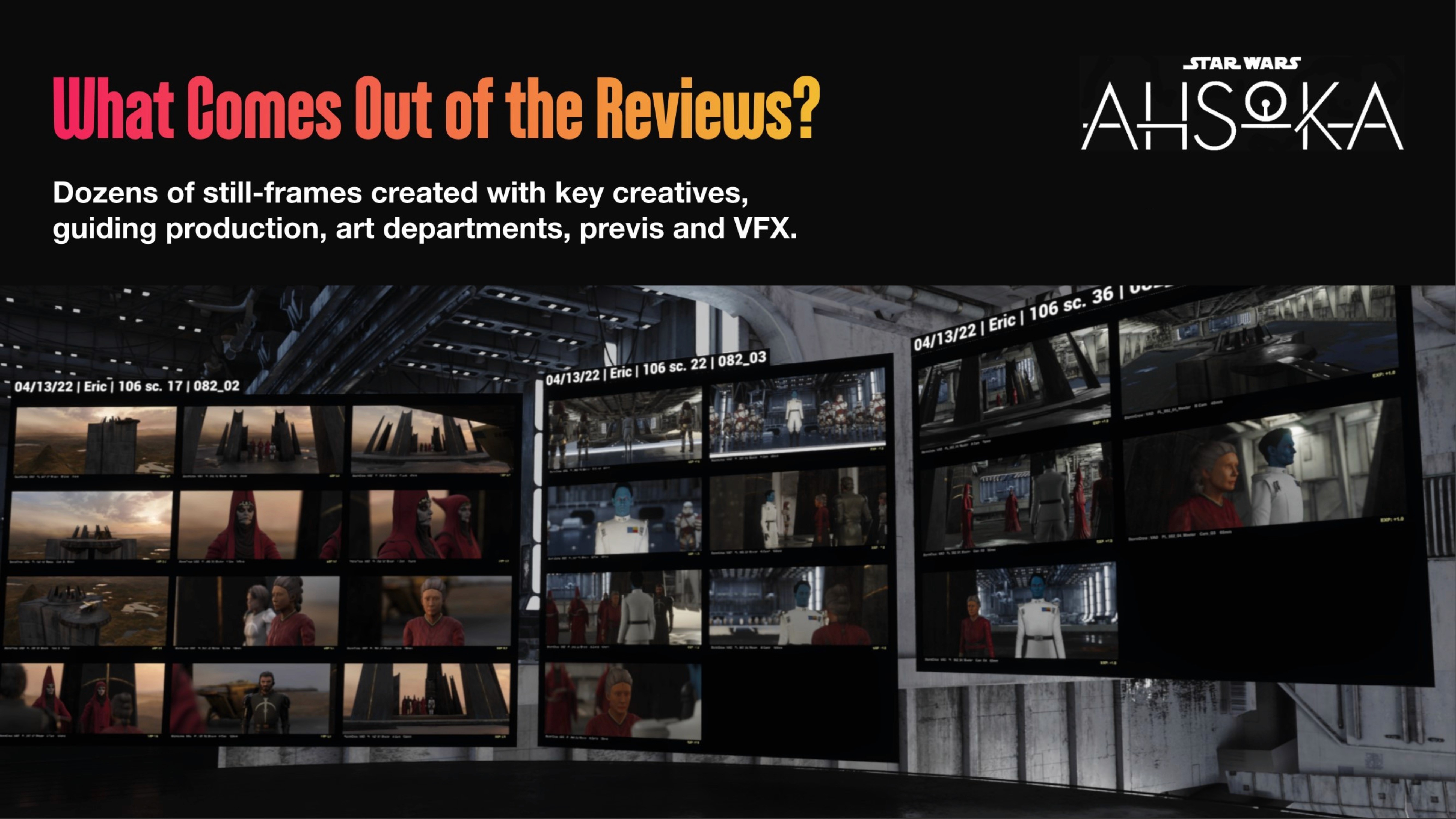
Ahsoka Virtual Storyboards primed for a review.
What are art departments delivering when adopting a Virtual Art Department workflow? A lot more looks, a lot earlier.
We pull still frames of the locations out of Unreal and send them to the concept and storyboard artists. They paint over them. Their paintings change our sets, and our sets change their paintings.
Still frames for the director, lit and framed with the cinematographer, and story beats hashed out together. The set decorator dresses the digital version too, whether it gets built physically or not, that eye raises the quality of the set.
Environments and assets get handed off to set designers, VFX, or virtual production. A lot of that responsibility is asset management, which needs to be meticulously tracked for legal reasons - one database that ingests from every team: previs, art department, VFX, virtual production, or online marketplaces. We use those assets to build the virtual locations. The filmmakers critique them in Unreal Engine, looking through a lens, and we kick frames and assets back to the team. Every week.
Producers get budgets that refine as the design evolves, and design evolves fast in a real-time process. With AI in the mix it’s faster still.
Thanks for reading. - Felix


